.png?width=162&height=64&name=IRWINS%20website%20logo%20(1).png "IRWINS website logo (1)")
by Irwin's Marketing Team, on Apr 22, 2026, 6:01:55 PM
In high-risk industries, safety performance is directly tied to operational discipline. Yet many organizations still rely on fragmented systems, paper forms, and delayed reporting. The result is predictable: gaps in compliance, slow response to hazards, and administrative overhead that pulls supervisors away from the field.
Safety management software platforms address this by centralizing safety processes into a single, structured environment. The objective is not just digitization. It is control, visibility, and consistency across sites, teams, and projects.
%20(2)-1.png?width=2100&height=1100&name=Irwins%20Safety%20Knowledge%20Hub%20(2100%20x%201100%20px)%20(2)-1.png)

What a Modern Safety Platform Should Deliver
At a minimum, a credible platform needs to standardize how safety data is captured, managed, and acted on:
• Incident reporting with real-time submission and escalation
• Digital inspections, audits, and checklists
• Training and certification tracking with expiry controls
• Equipment and asset management with maintenance logs
• Document control for policies, SOPs, and compliance records
• Field accessibility on mobile devices, including offline environments
The value is cumulative. When these components operate within one system, organizations reduce duplication, eliminate data loss, and improve audit readiness.
Operational Impact in the Field
The primary constraint in safety execution is not intent, it is friction. Paper-based processes introduce delays and inconsistencies:
• Reports completed hours or days after an event
• Missing or incomplete documentation
• Limited visibility for management until issues escalate
• Time lost on manual data entry and follow-up
A digital platform removes these constraints. Supervisors can log incidents immediately, complete inspections on-site, and trigger corrective actions in real time. Management gains immediate visibility into trends, non-compliance, and risk exposure.
The outcome is measurable:
• Reduced administrative workload for field teams
• Faster hazard identification and resolution
• Improved compliance with regulatory requirements
• Stronger audit performance and documentation integrity
Why Adoption Fails and How to Avoid It
Many software implementations underperform due to complexity. Systems that are difficult to use in the field are ignored, bypassed, or inconsistently applied.
Successful platforms share three characteristics:
• Simple user interface that aligns with how crews actually work
• Mobile-first design that functions without reliable connectivity
• Structured workflows that reduce decision fatigue rather than add to it
Without these, even the most feature-rich system becomes operationally irrelevant.
Wombat Safety Software: Practical Execution at Scale
-4.png?width=672&height=296&name=Untitled%20design%20(1)-4.png)
Irwin’s Safety partners with Wombat Safety Software to deliver a platform that aligns with real-world site conditions.
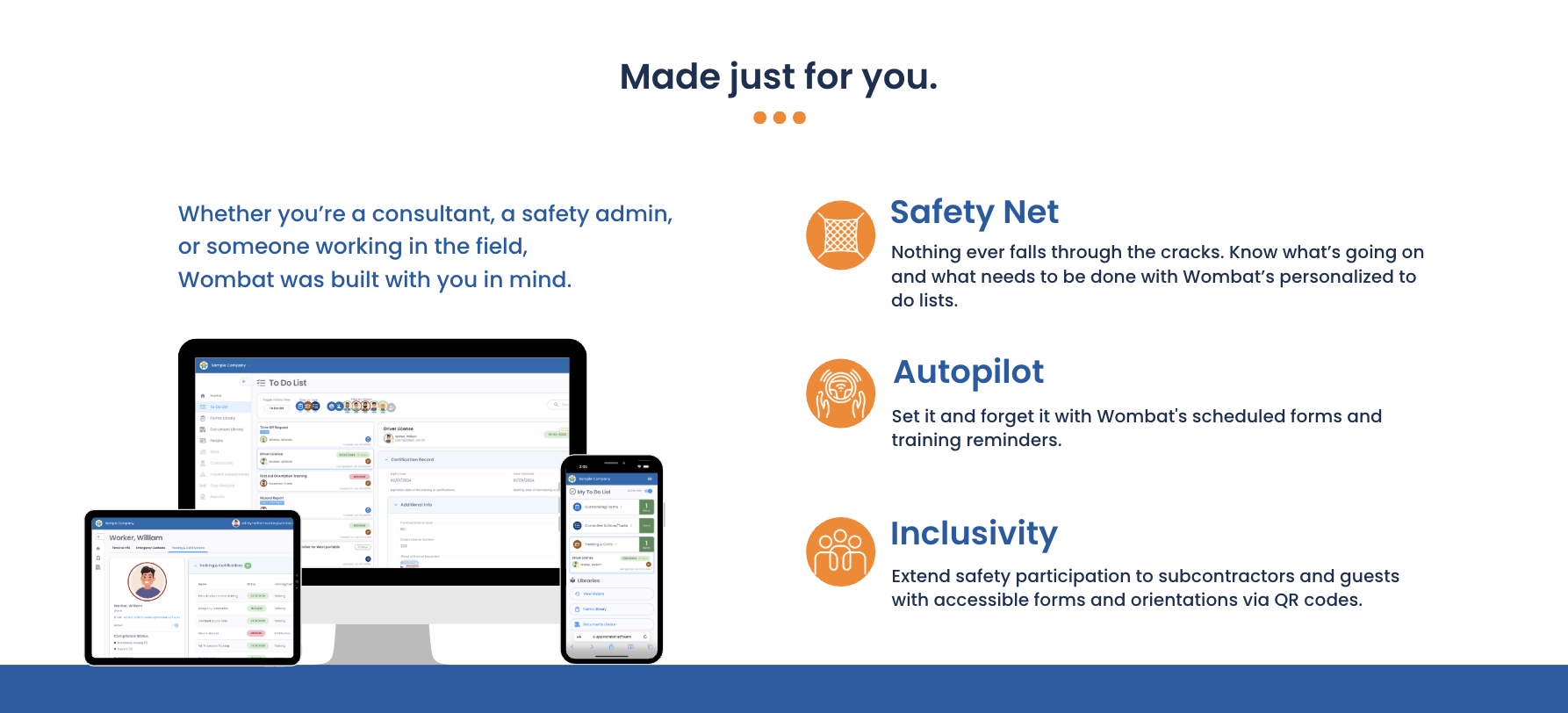
Wombat is designed to reduce administrative burden while improving compliance and operational control:
• Up to 40% reduction in administrative time through streamlined workflows
• Up to 30% reduction in safety-related administrative costs
• Full functionality in remote environments with offline capability
• Centralized management of incidents, training, equipment, and documentation
• Real-time data access for both field teams and management
What differentiates Wombat is usability. The system is built for crews, not just compliance teams. This increases adoption rates and ensures consistent data across projects.
A Complete Safety Ecosystem, Not Just Software
Software alone does not solve safety challenges. Implementation, process alignment, and training are equally critical.
Irwin’s Safety integrates Wombat into a broader safety framework:
• Consulting support to align the platform with your existing safety program
• Training to ensure teams adopt and use the system correctly
• Ongoing support to optimize workflows and reporting
This approach ensures the platform delivers operational value, not just digital storage.
When to Consider Transitioning to a Safety Platform
Organizations typically reach a tipping point when:
• Projects scale across multiple sites or regions
• Compliance requirements become more complex
• Incident tracking and reporting become inconsistent
• Administrative workload begins to impact field productivity
At this stage, a centralized platform is no longer optional. It becomes a requirement for maintaining control.
Start the Transition
If your current safety processes rely on spreadsheets, paper forms, or disconnected systems, the risk is not just inefficiency. It is reduced visibility and delayed response.
Irwin’s Safety can help you evaluate, implement, and operationalize a platform that fits your environment.
Talk to our team about Wombat Safety Software and see how it can be deployed across your operations.